This deck is private. Enter the access code to continue.
That's not the right code.
Built with MonDeck.AI · monsure.ai
Monsure · product deck
01 / 55
Choose language · 言語を選択
Welcome to the Monsure deck
Built with MonDeck.AI
Product deck · April 2026
Monsure
The configuration layer your core was missing.
What it is, what you ship in your first sprint, and what stays exactly
where it is on your AS/400.
The problem
18 months.
That's how long it takes a tier-1 insurer to ship a new product today.
Eighteen months from idea to first policy bound.
Industry average across LIMRA / Bain studies (2023–2025). Personal lines, simplified
cover. Complex commercial lines run 24–36 months.
The diagnosis
Three forces hold insurance hostage.
Not one of them is technology. All three are technology debt.
Force 01
The 1998 AS/400
Core systems from the green-screen era still hold 70% of in-force policies in mature markets.
Force 02
The migration trap
"We'll fix it with a five-year core replacement." Most replacements are mid-stride when the next one is announced.
Force 03
The IT ticket
Every product change is a project. Every project gets steerco'd. Every steerco slips a quarter.
Force 01 · The 1998 AS/400 inheritance
The core that won't die. And shouldn't have to.
AS/400 (now IBM i) cores still process the majority of life and general
policies in Asia and Europe. They're stable, fast, and audit-clean.
Replacing them is rarely the right answer.
What they can't
do is ship a digital-first product, expose a REST API, or talk to a
chatbot. They were never asked to.
Penetration
70%
of in-force policies still on legacy cores in mature markets.
Age
30+ yrs
average system age across tier-1 carriers.
Spend
$60B
annual maintenance spend, global, on cores no one wants to touch.
Continuity
3
CIOs since the last attempted rip-and-replace at the average tier-1.
Force 02 · The migration trap
"We'll fix it with a core replacement."
5-year realityEvery CIO has lived this story. Most are living it right now.
Year 0Sign with the new core vendor.
Year 1Discover 1,400 undocumented endpoints in the old core.
Year 2Split the programme in two. Add an SI partner.
Year 3CFO asks "where's the ROI?"
Year 4CIO leaves. New CIO restarts scope.
Year 5"When can we go live?"
And during those five years, the product catalogue is frozen.
Distribution partners churn. Innovation budget gets reallocated to
"stabilisation."
Monsure does not ask you to replace anything.
We sit on top of what you already have, and let you ship new
products against it — while the migration question stays open
(or doesn't).
Force 03 · The IT ticket
Every product change is a project.
01
Business writes a spec
12-page Word doc, three rounds of legal, six weeks of pricing actuarial.
6 weeks
02
IT estimates the change
Triage. Architecture review. Dependencies in 14 systems mapped.
4 weeks
03
Steerco approves
Or sends it back. Three quarterly cycles is normal.
12 weeks
04
Build, test, UAT, deploy
Hand-coded against the core. Custom UI. Custom integrations.
36 weeks
05
Go live
Hope the market still wants the product you scoped 14 months ago.
~58 weeks
Meanwhile
Banks and fintechs ship weekly. You can't keep up.
Your distribution partners are deploying twice a day. Your products take eighteen months
to update. The mismatch isn't a strategy problem — it's a math problem.
The fintech
8 days
From "let's offer travel insurance in our app" to first policy bound. They expect this from any partner.
The carrier (today)
14 months
By month 14 the fintech has launched a competing product, given up, or moved on to crypto loans.
The turning point
Configuration just got cheap.
AI changed the math. The marginal cost of describing a product, generating its APIs,
and producing its docs is now near zero. Monsure makes that the new default.
What used to be 18 months of build cost is now 18 minutes of declarative spec.
What Monsure is
Monsure.
The configuration layer your core was missing.
We sit on top of your core. Never replace it. Configure a product
once — Monsure ships the REST APIs, the SDK, the buy-flow, the
chat copilot, the embed widget, and an MCP server for AI agents.
All from the same definition.
What your customers, partners, and agents touch
Buy-flowChatEmbedMCPREST
requests
Monsure
Configuration · routing · audit
adapters
Your existing systems · stay where they are
AS/400CRMLedgerDWH
How Monsure sits in your stack
We sit on top. Never replace.
Where it shows up · for customers, partners, and agents
six adapter shapes · REST · SOAP · file · queue · DB · custom
Your existing systems · stay exactly where they are
Core
AS/400 · Guidewire
Identity
CRM · IDP
Ledger
Finance · GL
DWH
Snowflake · Teradata
Claims
Loss runs · history
How it plugs in · Six adapter shapes
Pluggable to anything already running.
REST · 01
HTTP / JSON
Modern cores, microservices, SaaS systems. Standard auth.
SOAP · 02
Enterprise XML
Guidewire, Duck Creek, every "modernised" core that still speaks WSDL.
FILE · 03
Batch file drop
SFTP / S3 / fixed-width. The AS/400 nightly run. We poll, parse, ack.
QUEUE · 04
Message bus
IBM MQ, Kafka, RabbitMQ. Pub/sub or request-reply, your choice.
DB · 05
Direct CDC
When the only API is the database. Read-only views or Debezium-style change capture.
CUSTOM · 06
Bring your own
A 200-line TypeScript adapter ships your weirdest legacy in a week. We've seen it all.
Data ownership
We never duplicate your customer master.
Customer identity, KYC results, claims history — that all stays in your CRM and your
core. Monsure references it by ID. We hold quotes, policies, and events we issued
ourselves; nothing more.
For DPO and CISO: there's no second copy of your book of business sitting in
another vendor's database. The blast radius of any incident is small.
In your CRM
Customer master
Identity, contact, segmentation, consent.
Yours
In your core
Claims history
Loss runs, reserves, recoveries.
Yours
In your DWH
Reporting
Actuarial, financial, regulatory.
Yours
In Monsure
Quotes & in-force policies
The ones we sold. Pointer-only to the customer ID.
Ours
Spec lifecycle
Versioned. Immutable. Auditable.
v1.0
Published
Live. Quoting and binding now. Frozen forever — every in-force policy points back to this exact spec.
v1.1
Draft
Edit freely. Diff against published. See quote-impact preview. Validate before publish.
v1.0 → v1.1
Migration
When you publish v1.1, new quotes use it. v1.0 policies stay on v1.0 forever. No migration required.
Renewals, claims, endorsements on a v1.0 policy run against the v1.0 spec — even years
later. Your auditor sees the exact code, rate card, and ruleset that priced any historical policy.
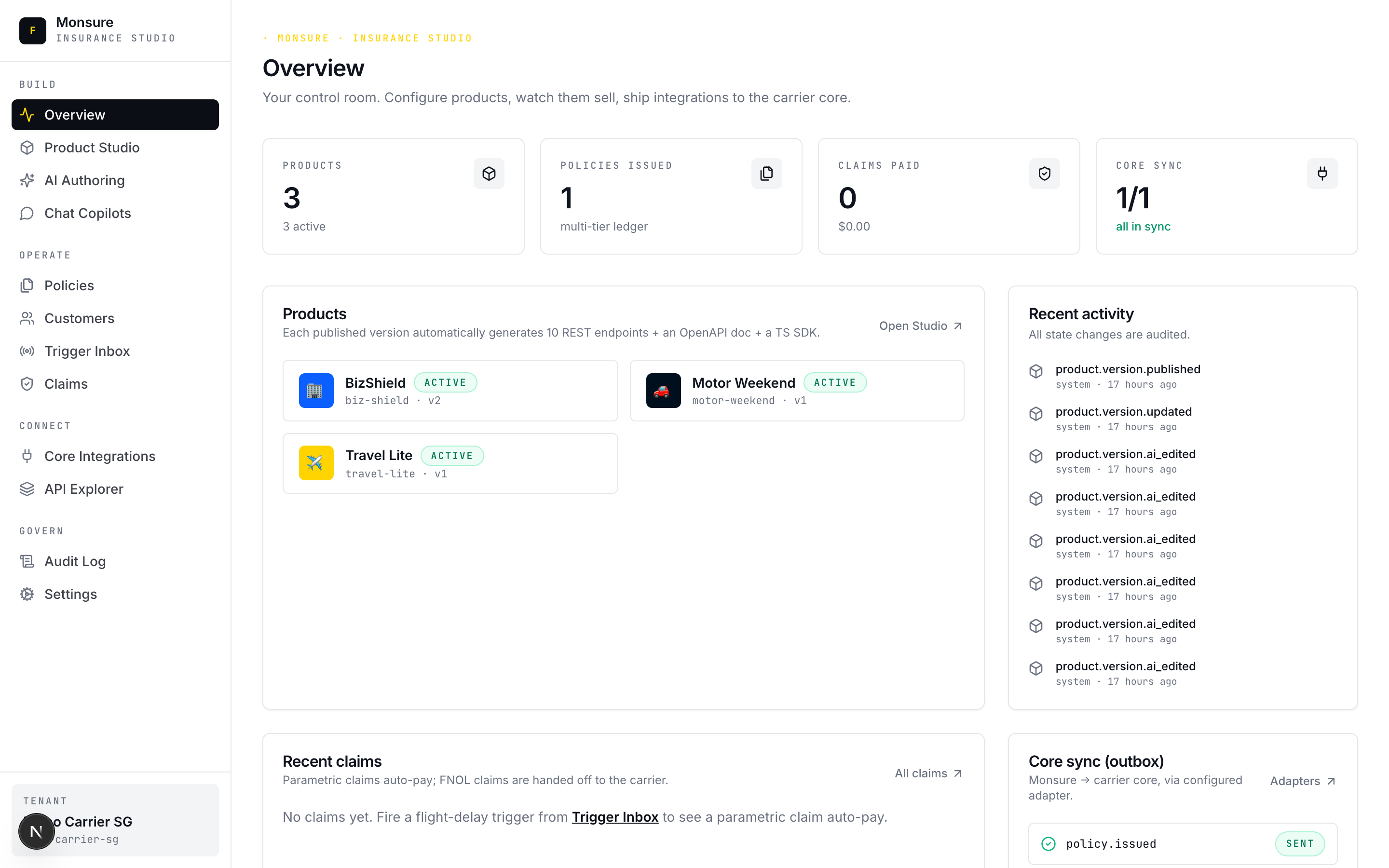
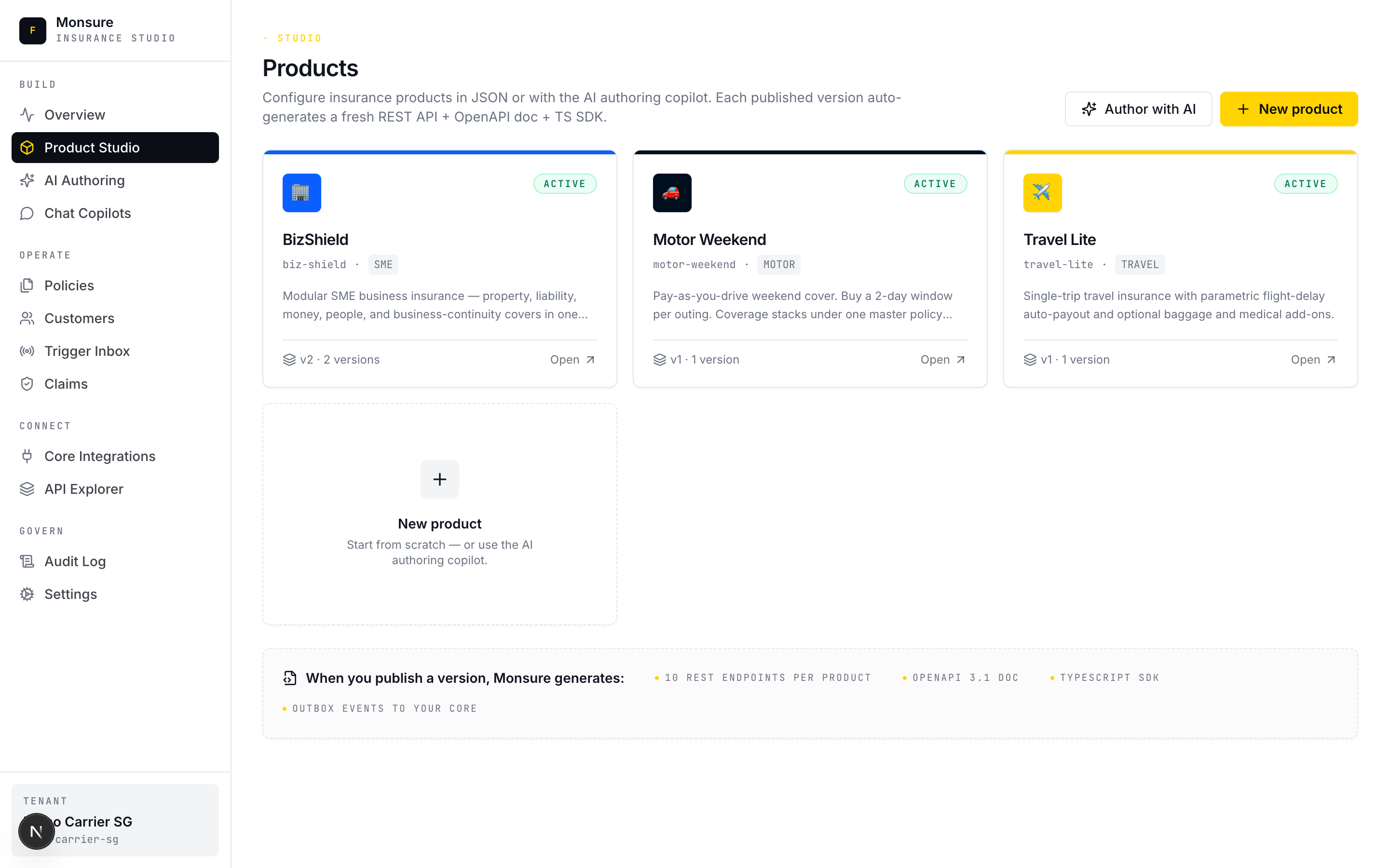
Three live products. Each with multiple published versions. The product is the unit of
configuration — not the page, not the form, not the API. The product.
Product creation · Auto-generated APIs
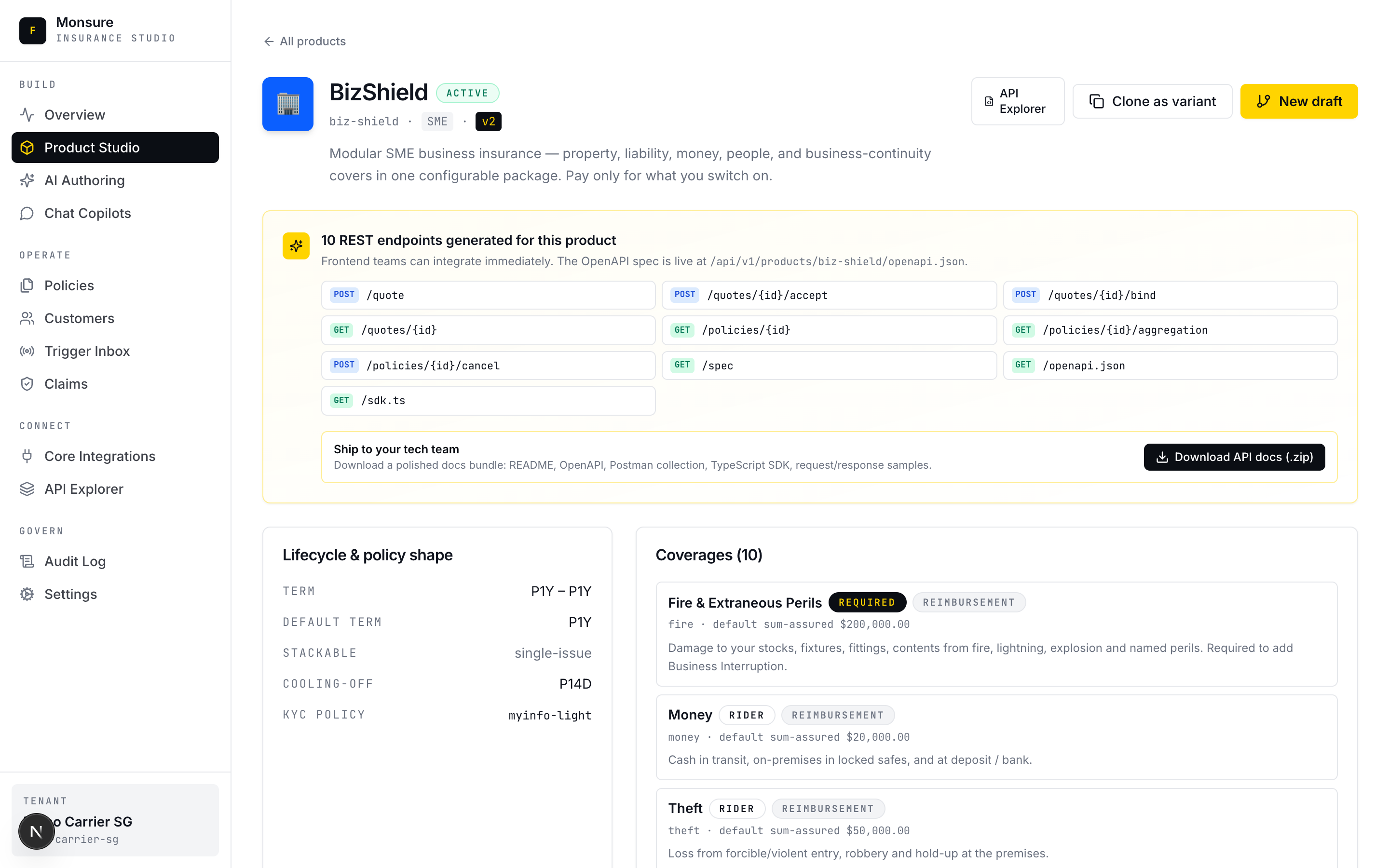
Publish once. Everything appears.
localhost:3000/products/biz-shield
10 REST endpoints. OpenAPI 3.1. TypeScript SDK. Downloadable docs bundle.
The yellow card is your tech team's day-one integration kit.
Product creation · The editor
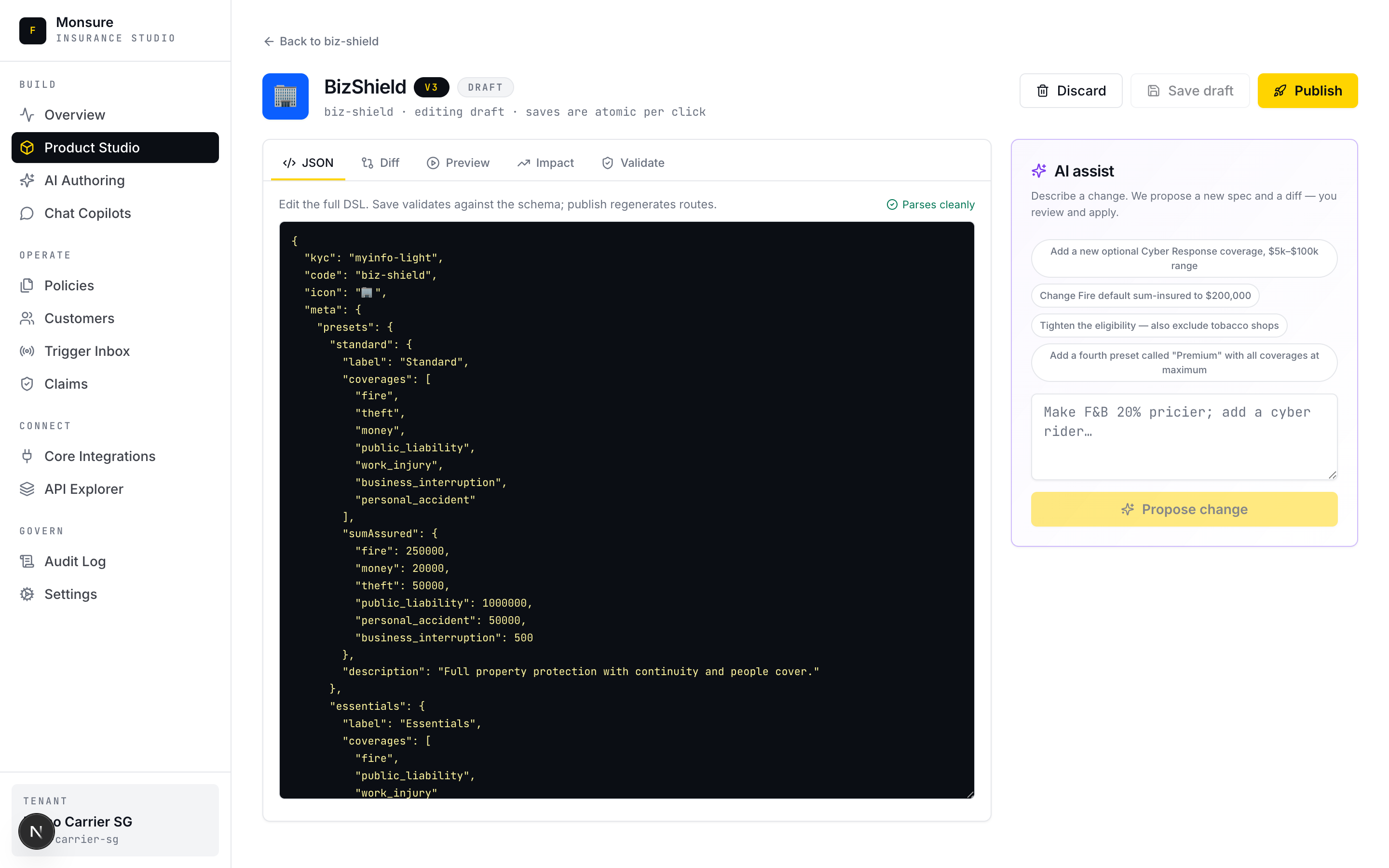
Edit the spec. Live.
products/biz-shield/edit/3
Drafts only — published versions are immutable. The editor lints as you type, with
the AI Assist rail on the right for natural-language patches.
JSON-Schema validation in real time
Hover for field-level docs
Autocomplete on rate-card and ruleset codes
Cmd-S saves; PATCH applied immediately
Product creation · The diff
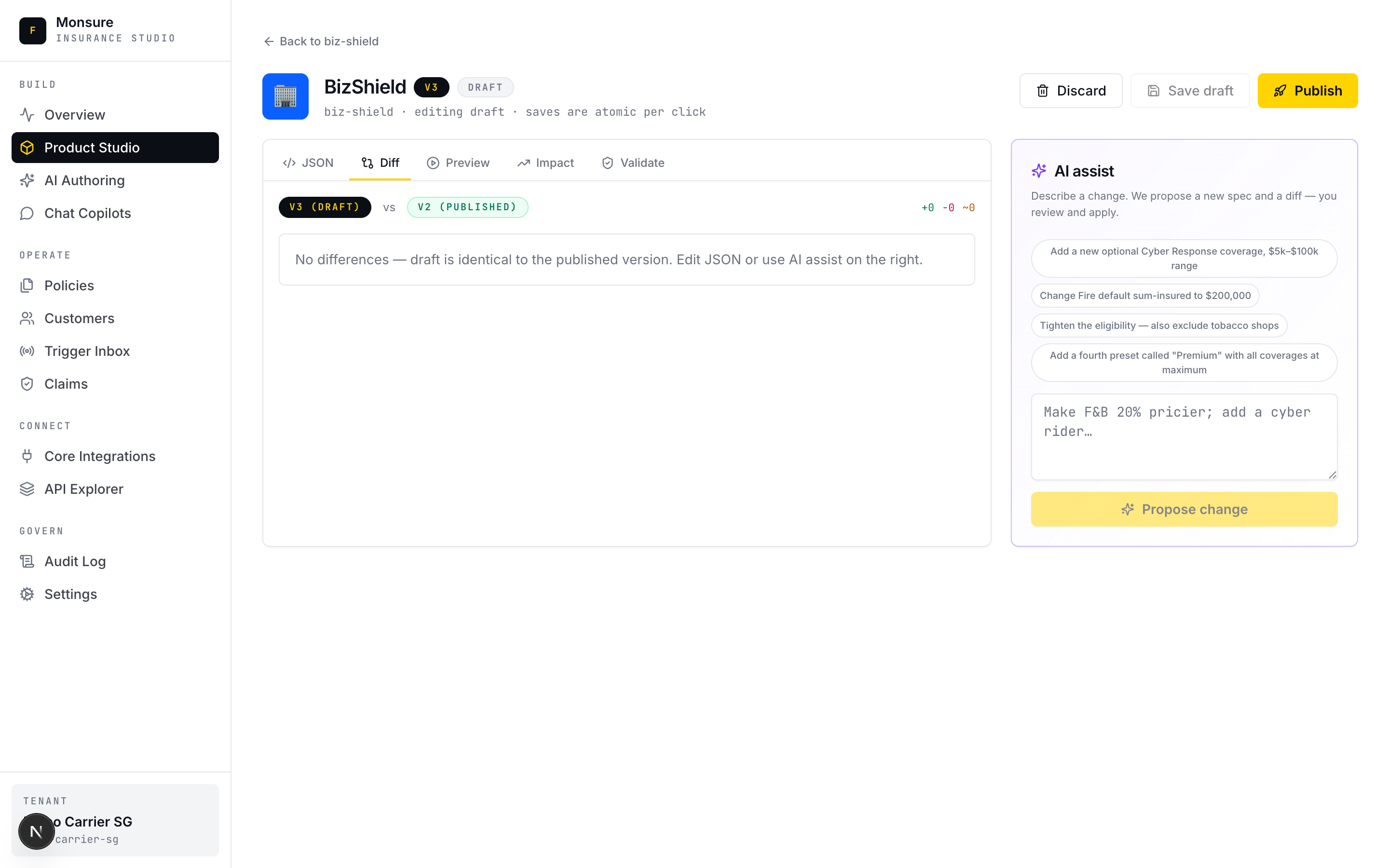
See exactly what changed.
Every draft has a live diff against the current published version. Field-level. Order-stable.
Reviewers don't need to read the whole spec — only the delta.
Reviewers see the change in business terms — coverage added, sum
insured raised, rate card switched. Not 800 lines of JSON.
products/biz-shield/edit/3 · Diff
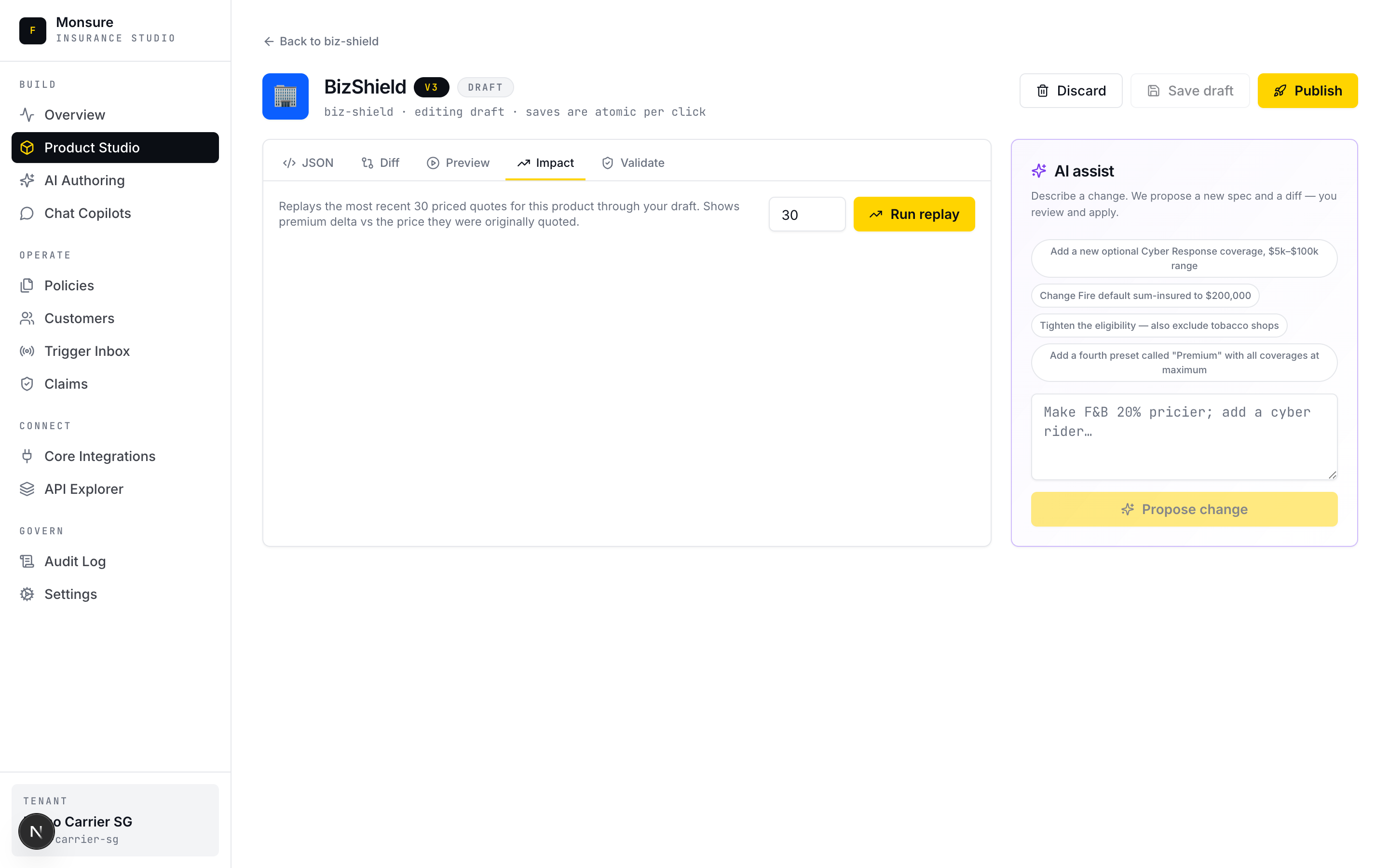
Product creation · Quote impact
Will this raise premiums? Find out before you publish.
products/biz-shield/edit/3 · Impact
The Impact tab re-prices a basket of representative quotes against the draft. You see the
median premium delta, the worst-case delta, and which quotes would be referred under the
new ruleset — before a single customer sees the change.
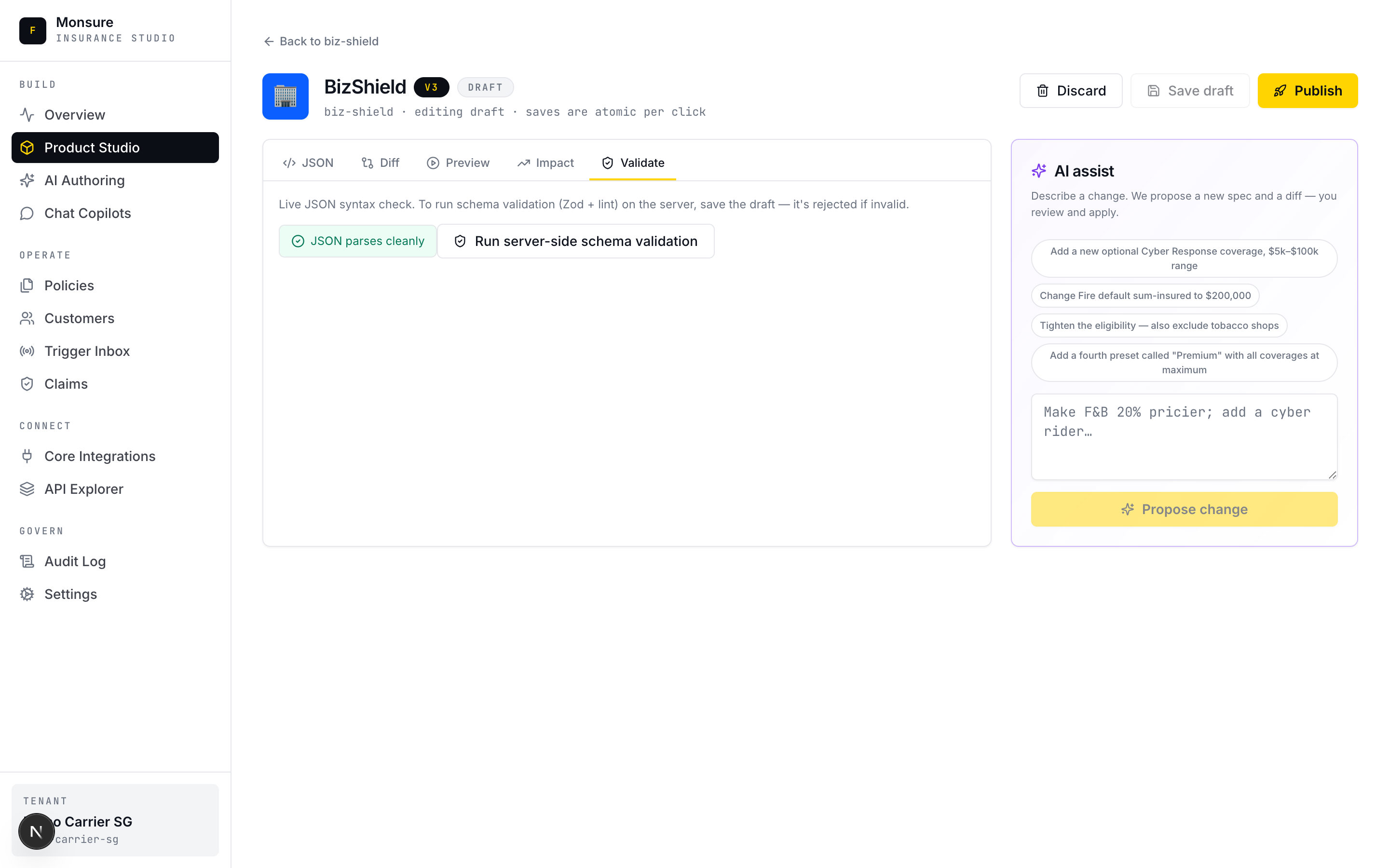
Product creation · Validate gate
Publish gate: no broken specs.
products/biz-shield/edit/3 · Validate
JSON-Schema, business rules, cross-references (rate card exists at the right version,
ruleset matches lifecycle), and parametric trigger sanity all pass before the
Publish button enables.
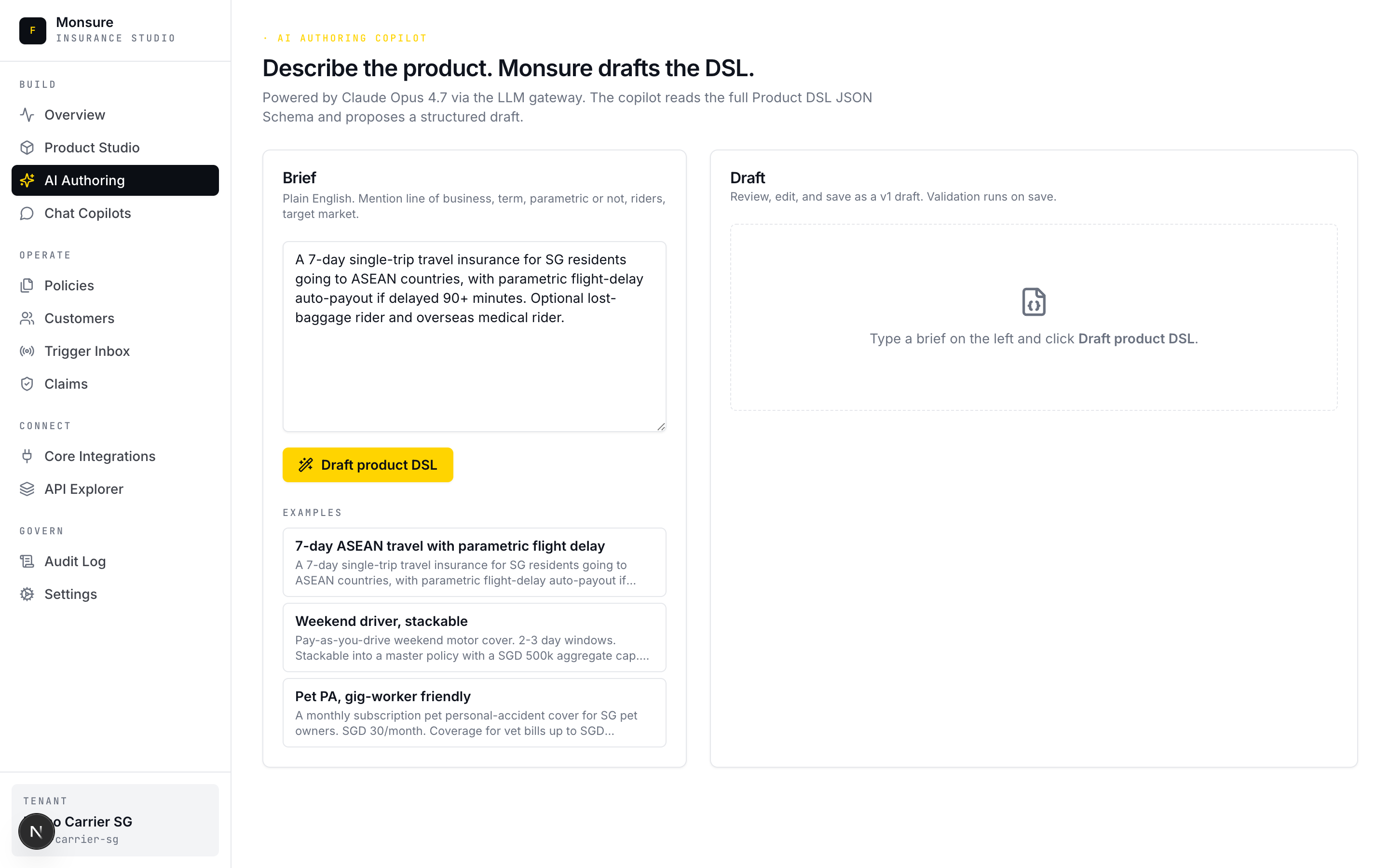
Type the change in plain English. Monsure returns a JSON-Patch diff against the
current spec, runs the validator, previews the quote impact, and shows you a
human-reviewable summary.
Prompt"Add a cyber liability rider with sum insured between SGD 50k
and 200k, and exclude crypto-related businesses from eligibility."
AI helps. Humans always approve. Nothing publishes without an explicit
click. The full audit log shows the prompt, the patch, and the reviewer.
localhost:3000/ai/authoring
What you get for free
Publish. APIs go live the same second.
What you get · 10 endpoints
Ten REST endpoints, on publish.
Quote & bind
POST /products/biz-shield/quote
POST /products/biz-shield/quotes/{id}/accept
POST /products/biz-shield/quotes/{id}/bind
GET /products/biz-shield/quotes/{id}
Policy & aggregation
GET /products/biz-shield/policies/{id}
GET /products/biz-shield/policies/{id}/aggregation
The spec is generated from the same Product DSL. Every field, every validator,
every status code. Codegen-ready. Hand it to your tech team and they're shipping.
OpenAPI 3.1.0 — JSON-Schema-aligned
Examples on every operation
Tagged by domain — quote, policy, claim, meta
Bearer auth + scopes documented inline
docs.html in the bundle ships a Redoc-rendered
three-pane reference — the format your engineers already use
from Stripe and Twilio.
Single file. Strict types. No runtime dependencies. Your bundler will tree-shake what
you don't use. For other languages, generate from openapi.json
with the standard openapi-generator.
What you get · The docs bundle
A docs bundle, ready to ship.
One click. One zip. Everything a frontend team needs to integrate. Your CIO can
forward this to the partner bank's CTO and call it a day.
17
files in the bundle
192 KB
compressed (zip)
~5 min
to first authenticated call
biz-shield-v2-docs.zip
├── README.md # quickstart, auth, errors, rate limits
├── CHANGELOG.md # diff vs previous published version
├── docs.html # Redoc-rendered, branded
├── docs.pdf # print-quality PDF reference
├── openapi.json
├── openapi.yaml
├── postman_collection.json
├── sdk/
│ ├── biz-shield.ts # typed TS SDK
│ └── example-quote.ts # quote → bind walkthrough
├── examples/ # real samples for every endpoint
│ ├── createquote.request.json
│ ├── createquote.response.json
│ └── …
└── schemas/
└── product.dsl.json # DSL pinned to this version
Every endpoint, with {{BASE_URL}} and
{{MONSURE_API_KEY}} placeholders. Your QA can
click-test the API before any code ships.
Samples
Real requests & responses
Synthesised from the OpenAPI schema with sensible defaults — UUIDs, ISO dates,
email formats. examples/createquote.request.json works
verbatim against the test environment.
Not next sprint. Not next quarter. The bundle is dense enough that a senior frontend
engineer is hitting authenticated endpoints before lunch.
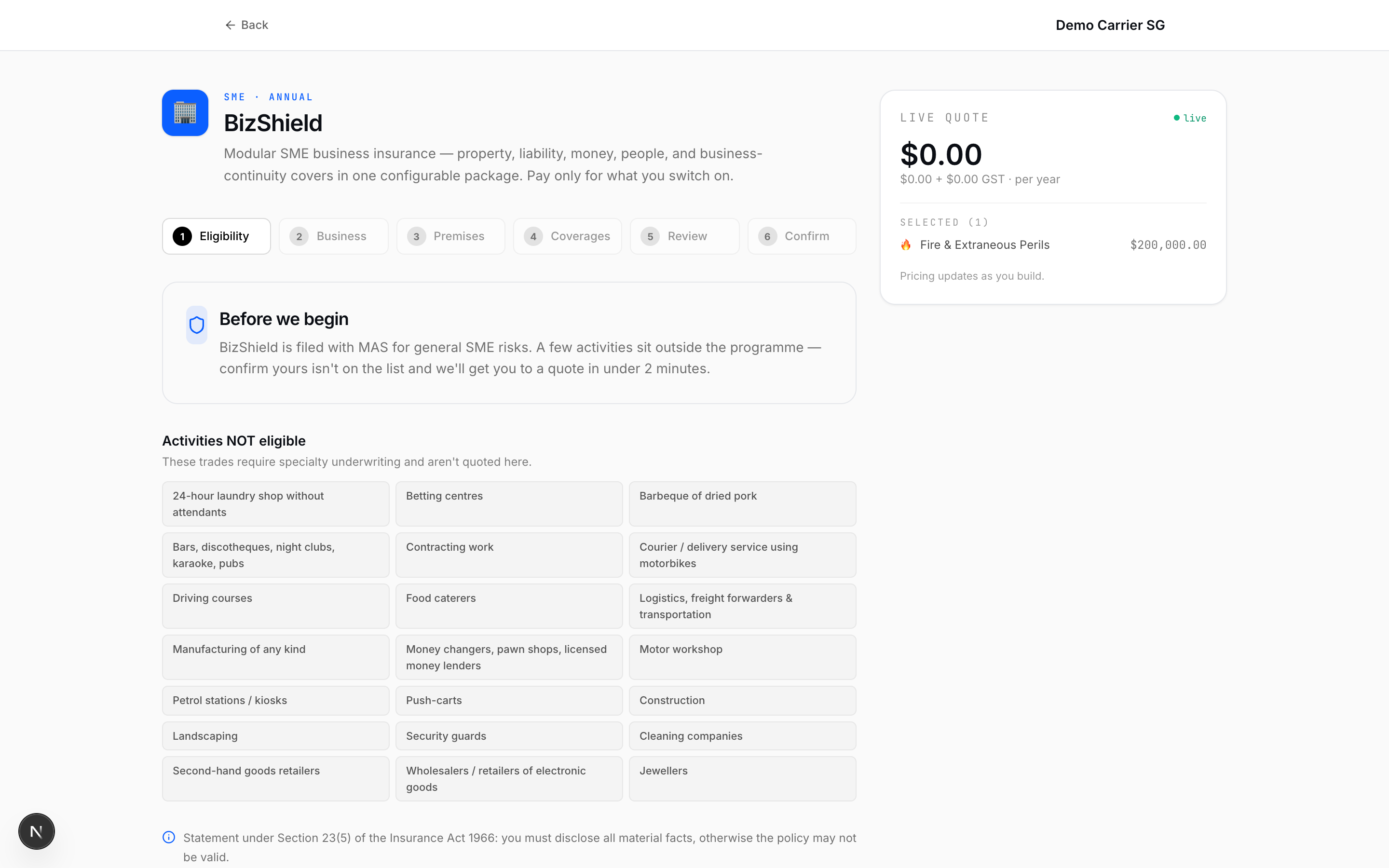
Distribution · The customer buy-flow
The customer buys here.
localhost:3001/buy/biz-shield
The spec drives the wizard. BizShield is six steps because BizShield needs six.
A travel-lite product can be one. A complex commercial product can be twelve.
Live quote rail re-prices as the customer types. Mobile-first.
Re-quoting on every meaningful field change — debounced, cached, sub-200ms. The
quote rail isn't a sales gimmick. It's the only way to keep modern conversion rates
on a complex commercial product.
Your underwriters already have these factors in the rate card. We just expose them
in the UX.
~150ms
median quote round-trip
+38%
conversion vs. submit-and-wait flows
−62%
drop-off at the price-reveal step
Distribution · Chat copilot
…or buys here, in chat.
Per-tenant persona. Scoped to a product allowlist. Customers
quote, ask coverage questions, and file claims — all in chat.
Same backend endpoints as the buy-flow.
No human handover. The copilot resolves the
postcode, picks the right rate factors, streams a real quote,
and presents a one-tap bind. Underwriting referral only when
the spec says so.
Persona per tenantProduct allowlistReal quote, real bindAudit-logged
BizShield copilotDemo Carrier SG · live
I run a 5-person bakery in Tampines. What would I pay for cover?
Got it — bakery, 5 staff, Tampines. Annual revenue?
Claude — or any MCP-compatible agent — quotes, binds, and claims natively. The
agentic distribution channel that didn't exist eighteen months ago.
User in Claude Desktop"Quote a Singapore travel policy for a 35-year-old going to Japan for 7 days, and bind it on my Visa Gold."
monsure-mcp · tools/listlist_products— enumerate available productsget_product_spec— fetch the DSL for a productget_openapi— fetch per-product OpenAPI 3.1create_quote— price a quoteaccept_quote— move quote to ACCEPTEDbind_quote— bind a quote into a policyget_policy— fetch policy by idcancel_policy— cancel an in-force policyfile_claim— open a new claimlist_claims— enumerate claims for a customer
Same auth, same shapes, same idempotency keys as every other surface.
Distribution · Recap
Five places. One product spec.
01
Buy-flow
Web + mobile.
02
Chat copilot
Per-tenant persona.
03
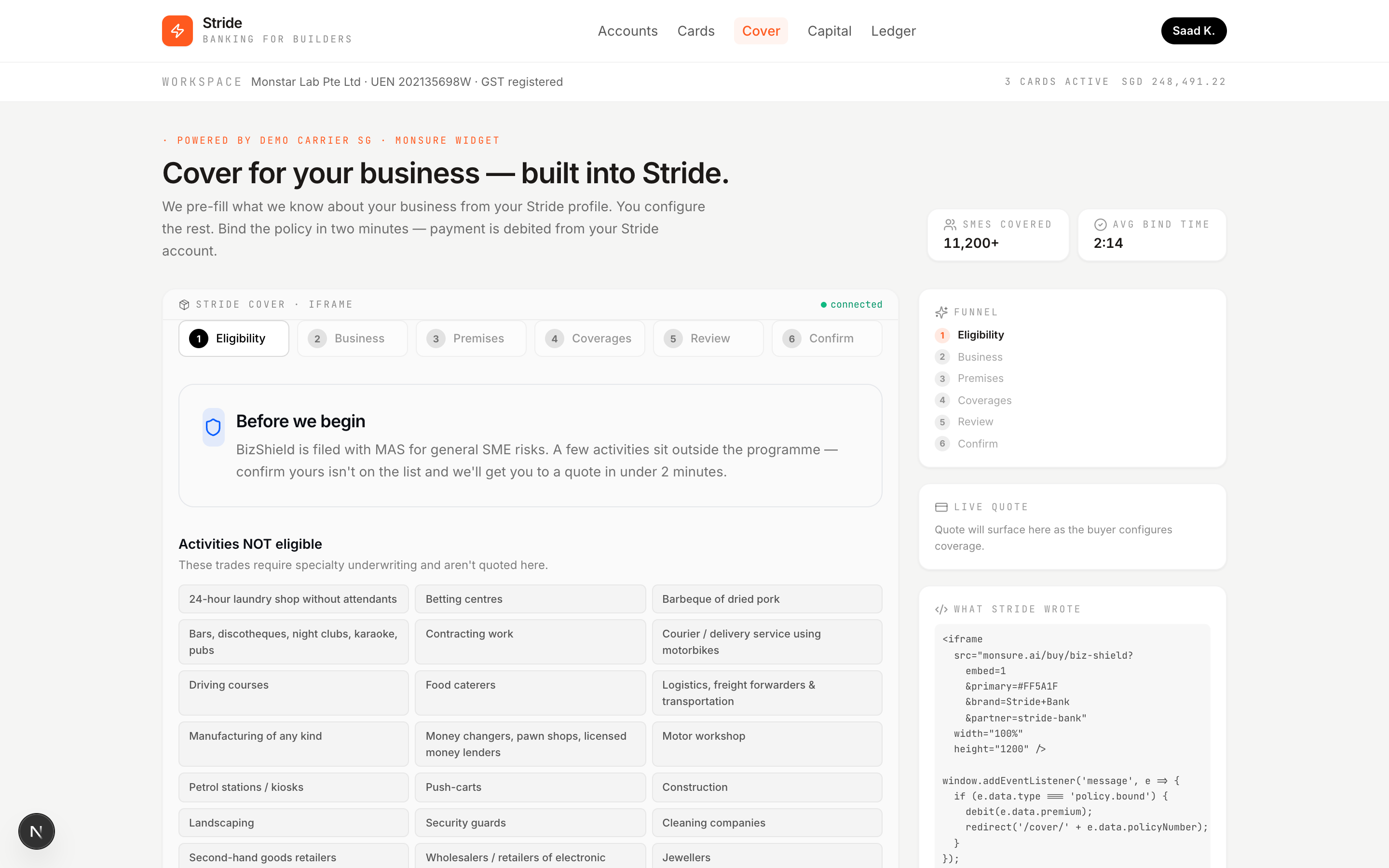
Embed widget
Drop-in iframe.
04
MCP server
For AI agents.
05
REST API
Anything else.
Edit the spec — every surface updates. Add a coverage — every surface offers it.
Bump the rate card — every surface re-prices.
The shift
The buyer chooses the channel.
Not the carrier. Not the platform. The buyer. Web today, chat tomorrow, agent next quarter.
Integration · Six adapter shapes
Six adapter shapes. Pick what fits.
REST · 01
HTTP / JSON
For modern cores. We speak OAuth, mTLS, and api keys.
SOAP · 02
Enterprise XML
WSDL ingestion + mapping DSL. Faster than your old SI quoted you.
FILE · 03
Batch file drop
SFTP / S3 / network share. Fixed-width or CSV. Hourly, nightly, you choose.
QUEUE · 04
Message bus
IBM MQ, Kafka, RabbitMQ, ActiveMQ. Pub/sub or req-reply.
DB · 05
Direct CDC
Read-only views or Debezium-style change capture. Last-resort but supported.
CUSTOM · 06
Bring your own
A 200-line TypeScript adapter ships your weirdest legacy in a week.
Integration · The AS/400 batch story
"But our core only does batch."
We've got you. Most carriers we talk to have at least one core that ships data via
an overnight file drop. Our file adapter handles it natively — and surfaces the
real-time gap to your product team so they know what to expect.
"The customer can quote and bind 24/7. The core sees the new policy at 2 AM in the
next nightly batch. Reconciliation happens at 3 AM. Your underwriters have the
morning report." — that's how it actually works.
23:55
File staged
Monsure writes the day's policy events to a fixed-width file.
us
02:00
SFTP drop
The core's nightly job pulls and applies.
us
03:00
Reconciliation
Diff: what we sent vs. what the core posted. Mismatches surface to ops.
us
07:00
Morning report
Your underwriters see clean reconciled numbers.
your team
Integration · Outbox + reconciliation
Outbox + reconciliation. No lost messages.
Step 01
Outbox write
Every state change writes to an outbox table in the same DB transaction. Atomic.
Step 02
Adapter dispatch
A worker drains the outbox to your core via the configured adapter. Retries with backoff.
This is the pattern your CTO would build if she had six months. We ship it on day one.
Failed messages don't disappear — they sit in the outbox until they succeed or get
manually resolved.
Integration · Data ownership
Your CRM holds your customers. Always.
Identity & relationship · stays yours
CRM
Salesforce · Dynamics
IDP
Ping · Azure AD · Okta
KYC
Singpass · in-house
Consent
PDPA register
↑↓ customer-id lookup · zero duplication
Monsure
References customer by ID. Never copies the master record.Holds only what we issue: quotes, policies, events.Forwards DSARs & consent flips back to your CRM in real time.
↓↑ policy & claim sync · adapter-driven
Records of issue & reporting · stays yours
Core
AS/400 · Guidewire · DuckCreek
Ledger
Finance · GL
Claims
Loss runs · history
DWH
Snowflake · Teradata
Integration · Singpass MyInfo
Singpass MyInfo — included.
We're Singapore-built. Singpass is the easy one. The buy-flow can prefill NRIC,
address, employment, and (with full MyInfo) income — with one tap. Drop-off
collapses; KYC overhead disappears.
myinfo-lightmyinfo-fullenhanced-cdd
KYC
myinfo-light
NRIC, residency status, basic demographic.
live
KYC
myinfo-full
Full MyInfo — income, address, employment, education.
live
KYC
enhanced-cdd
PEP / sanctions / AML — via your provider of choice.
configurable
The promise
Your core stays where it is.
We are not a core replacement. We are not a CRM. We are not a data warehouse. We are
the layer that ships product, on top of what you already trust.
Auth · Three credentials
Three credentials. One middleware.
Credential
Used by
Scope
Header
Tenant API key · mk_live_…
Partner backends, frontend BFFs, MCP server
Whole tenant, scoped per key
Authorization: Bearer mk_live_…
Customer JWT
End-users in buy-flow / chat
Single customer, single product, 30-min TTL
Authorization: Bearer eyJ…
Studio JWT
Admin app users
Tenant + role-based
Authorization: Bearer eyJ…
One Hono middleware in front of every route. Detects the bearer prefix, resolves the
principal, sets request context. RLS in Postgres enforces tenant isolation downstream.
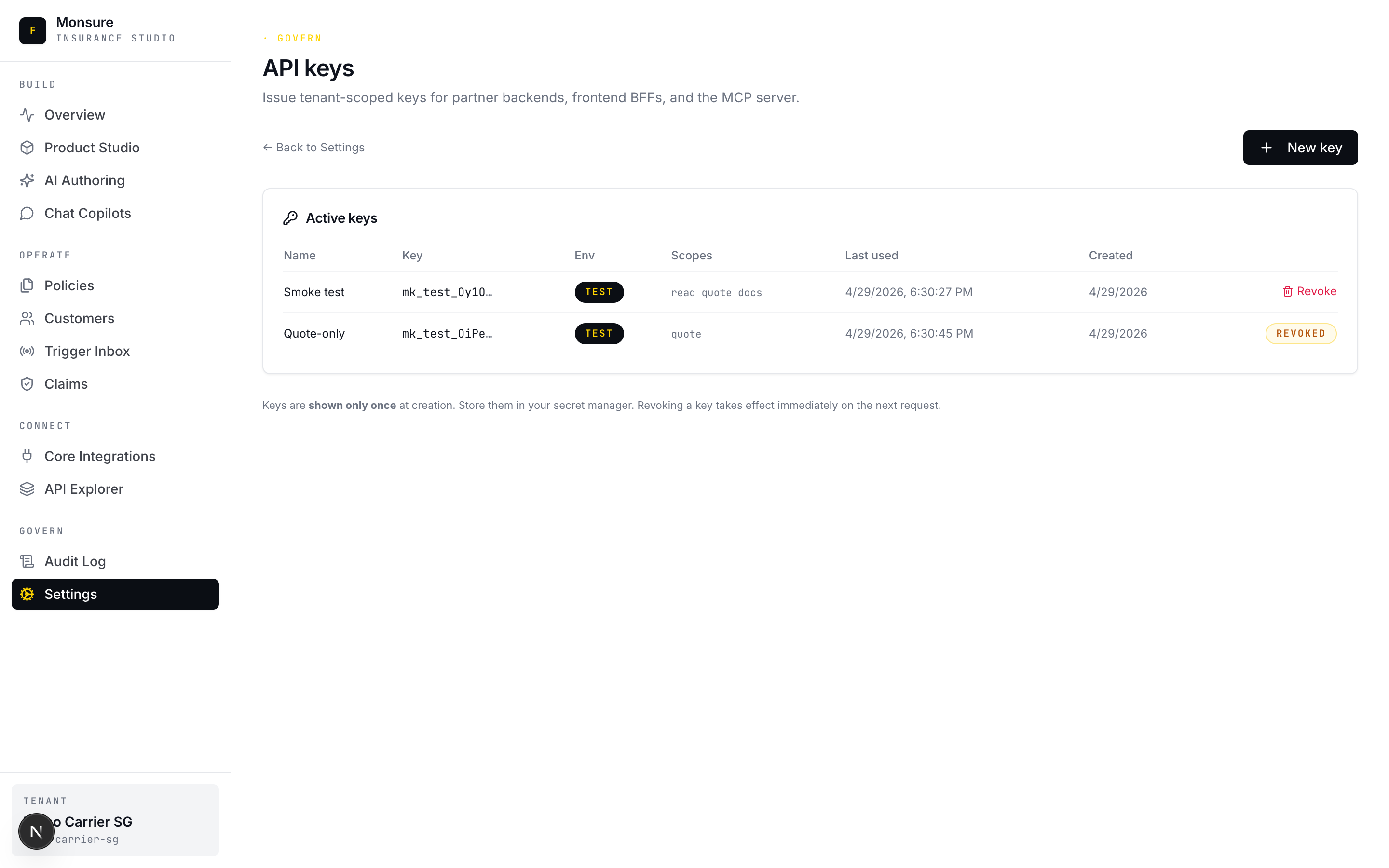
Auth · Tenant API keys
Tenant API keys. Self-serve.
localhost:3000/settings/api-keys
Create, list, revoke. Plaintext shown exactly once at creation, then sha256 hashed.
lastUsedAt tracked per key. Revocation is immediate.
live · test envsscoped per keysoft-revoke for audit
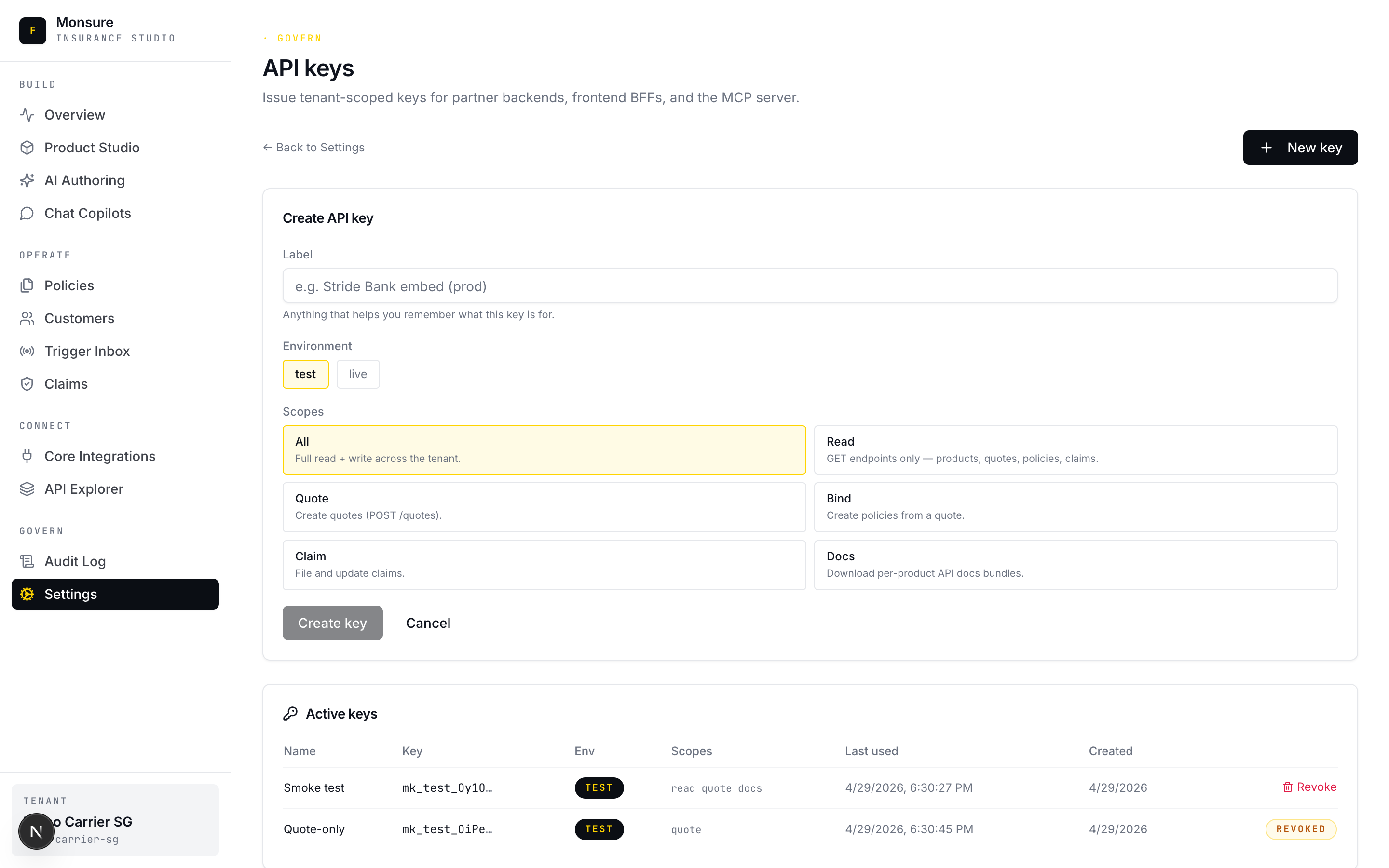
Auth · Scoped credentials
Scopes per key. Least privilege.
Quote-only key for the partner front-end. Bind+claim key for the back-office
integration. Read-only key for the data team's reporting pipeline. Six scopes, any
combination, immediate effect.
*
Everything below
read
All GET endpoints
quote
POST /quote
bind
POST /policies + amendments
claim
POST /claims + updates
docs
Download per-product docs bundle
settings/api-keys · New key
Audit · Logged forever
Every change. Logged. Forever.
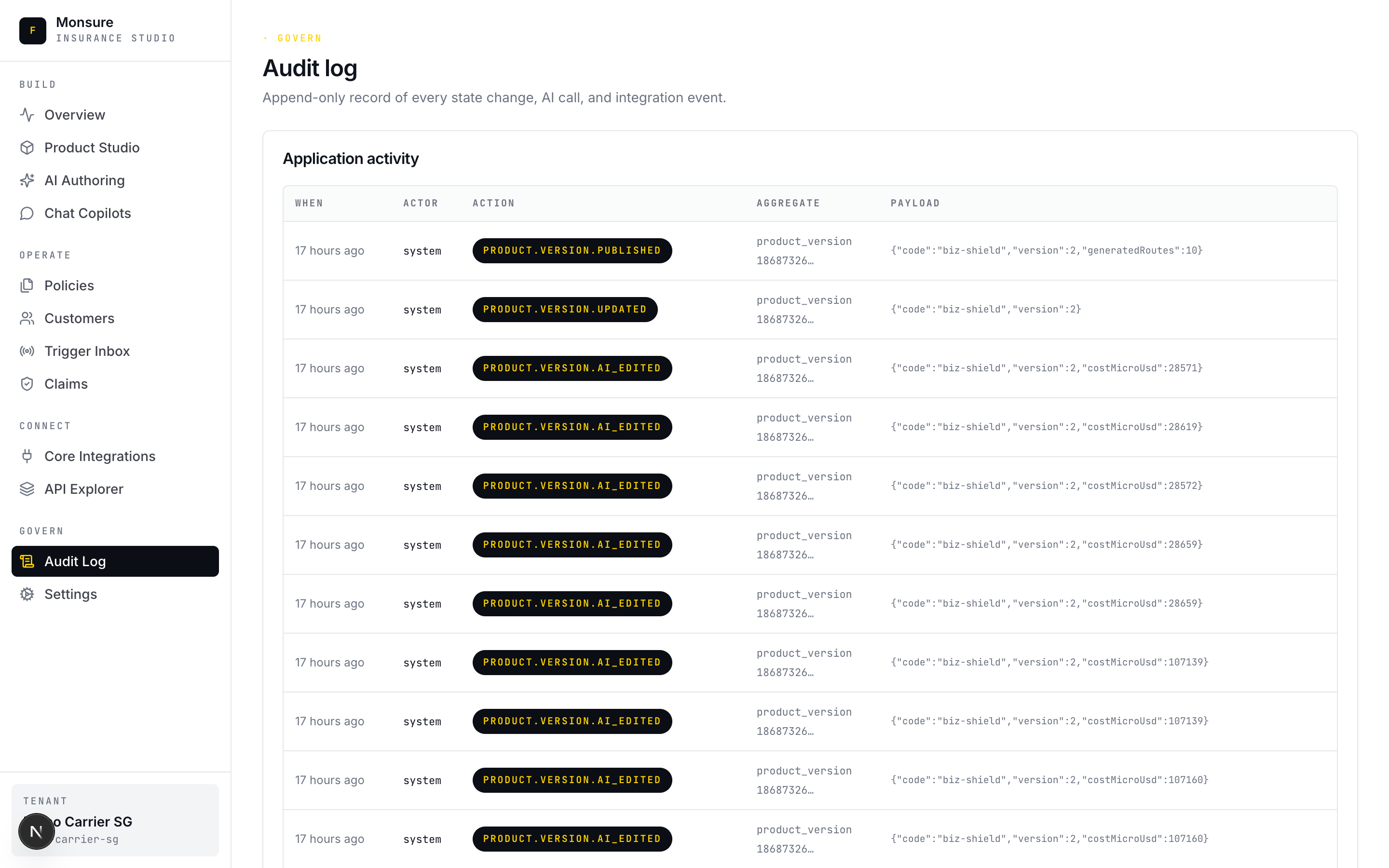
localhost:3000/audit
Every product version, every AI prompt & response, every API call, every webhook
delivery, every rate-card publish. With actor, IP, request-id, and the full diff.
Your auditor gets one URL and a date range. We log everything regulators ask about
— and a few things they haven't started asking about yet (LLM outputs, agent calls).
Compliance · Singapore-first
Speaks the frameworks you already work to.
MAS · operational
Notice 117 · 124 · TRM
Supports the artefacts your auditor expects: outsourcing register,
exit plan, RTO/RPO, cyber-hygiene controls mapped to TRM. SOC 2
Type II target on the SaaS option.
MAS FEAT · AI for FSI
Fairness · Ethics · Accountability · Transparency
Every AI-suggested patch records the prompt, output, reviewer,
model version, and per-product risk tier — the evidence FEAT
and Veritas reviews ask for. Human approval is mandatory before
publish.
PDPA · GDPR
Data minimisation, by design
No customer master in our DB — references only. DSARs forwarded
to your CRM. DPA & sub-processor list available. Singapore
data residency as the default.
Also supported, in one line each:
IMDA Model AI Governance Framework (incl. Gen AI 2024 addendum) ·
IMDA AI Verify test harness · MAS Notice on Cyber Hygiene ·
ISO 27001 mappings · EU AI Act high-risk metadata schema (for international rollout).
Compliance · Deployment
Three ways to run it. All yours.
Multi-tenant
Monsure SaaS
Shared infrastructure. Fastest start.
HostedAWS ap-southeast-1 (SG)
Operated byMonsure
TenancyShared
ComplianceSOC 2 Type II
Right for design partners, MGAs, and proof-of-value pilots.
Dedicated · single-tenant
Monsure Enterprise
Dedicated private cloud. We manage it. You have full access.
HostedYour region · your AWS / Azure / GCP
Operated byMonsure (24×7 SRE)
TenancySingle-tenant
AccessFull · console, logs, DB read-only
Right for tier-1 carriers in production. Strict residency without operational burden.
Bring your own cloud
Self-hosted
Your VPC. Your runbook. We ship Helm + Terraform.
HostedYour private cloud · on-prem option
Operated byYou
TenancySingle-tenant
AccessTotal. We never touch the runtime.
Right for regulated workloads with hard "no third-party operator" constraints.
Customer data stays in your CRM and your core in every mode.
Monsure never holds your customer master — so "where Monsure runs" is
an operational choice, not a data-residency one.
The math
The marginal cost of a new product, redrawn.
Five dimensions. Each one collapses by an order of magnitude. Watch the
last one — AI is resetting buyer expectations faster than legacy carriers can ship.
Time to first sale
14–18 months
→
1–4 weeks
~50× faster
Cost
$1.5M – $4M
→
< $80K
~40× cheaper
Team
8–14 people
→
1 product editor + 1 engineer
~85% smaller
Iteration cadence
0–2 per year
→
Weekly
~50× more
Market risk
Buyer expectations are being reset by AI faster than you can ship
→
Iterate as the buyer's expectations move
Stay in the market
Not aspirational. Two design partners are running this cadence right now, in production,
in Singapore.
Why Monsure
Where the alternatives stop short.
Capability
Hand-builtYour team alone
Legacy coreGuidewire · DuckCreek
Digital nativePeak3 (ZA Tech) · InsureMo · Bolttech
AI native · 2026Monsure
Time to ship a new product
✕14 months
✕9 months
~3 months
✓1–2 weeks
Natural-language authoring
✕None
✕None
✕None
✓Native, audit-logged
Sits on top of your core
~If you build it
✕Wants to replace
✕Wants to replace
✓Always
Customer master stays yours
✓Yes
✕Duplicates
✕Duplicates
✓Never duplicated
Auto-generated docs bundle
✕Hand-written
~Wiki
~Wiki
✓Per publish
MCP / agentic surface
✕None
✕None
✕None
✓Day one
Singpass MyInfo
~Custom build
~Add-on
~Add-on
✓In the spec
Self-hosted & dedicated options
✓Yes
✕No
✕No
✓Three modes
Where the lock-in lives
~In your team
✕In the vendor
✕In the vendor
✓In your own DSL
Get started
Book a demo
We'll spin up your tenant by the end of next week.
A 60-minute deep dive on your stack. We bring product, engineering, and a working
tenant with one of your products already configured. No slides — just the platform.
 Monsure · product deck